Honor in Matthew 22
A Third Allegiance We Often Miss

“Jesus replied: ‘Love the Lord your God with all your heart and with all your soul and with all your mind. This is the first and greatest commandment. And the second is like it: ‘Love your neighbor as yourself.’ All the Law and the Prophets hang on these two commandments.” – Matthew 22:37-40
By the time we reach Matthew 22, Jesus is standing in the temple during His final week before the cross. The tension is thick. The religious leaders have already resolved to destroy Him, and their questions are not sincere – they are calculated. They come in coordinated waves: Pharisees, Herodians, Sadducees, legal experts. Each group brings a question designed to trap Him, twist His words, or force Him into a no-win situation.
Jesus is surrounded by manipulation, pressure, and hidden agendas. And yet, He remains steady, rooted, and whole – utterly aligned with the Father. This is the context in which He speaks of honor.
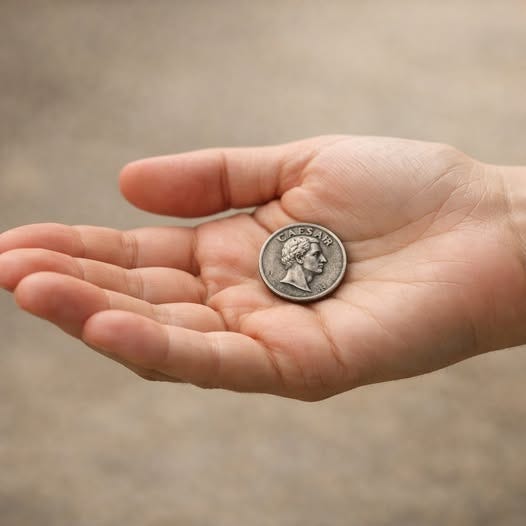
When the Pharisees and Herodians ask about paying taxes to Caesar, Jesus exposes the deeper issue beneath their political trap. He holds up a coin and names the divided loyalties inside every human heart.
Caesar’s image is on the coin, but God’s image is on you. Coins can be surrendered without cost to the soul, but the self – the mind, the will, the affections–belong wholly to God.
This isn’t just a clever answer. It’s Jesus modeling integrity under pressure – showing us that a life anchored in God cannot be manipulated by fear or false choices. His clarity frees us from the illusion that we must choose between obedience and the life God has entrusted to us. We don’t have to hand ourselves over to expectations God never placed on us.
Two Questions, One Revelation
Matthew 22 contains two major questions meant to ensnare Him – one about taxes, one about the greatest commandment. In both, Jesus refuses the categories His opponents handed Him. Instead, He reveals a deeper truth about ordered allegiance.
When He says, “Give to Caesar what is Caesar’s, and to God what is God’s,” He affirms that earthly authorities have a place, but they do not own the human soul. Only God does.
And when He adds, “Love your neighbor as yourself,” He assumes something we rarely name: a self that is tended, valued, and not surrendered to the demands or expectations of others.
The Part We Struggle to Believe
Many of us fear that honoring our own God-given life is selfish.
But Jesus’ words make it clear:
You cannot love God with your whole being or love your neighbor well if you have abandoned the self that God entrusted to you.
This is not self-centeredness or indulgence but sacred self-stewardship – the kind that allows love to flow from wholeness rather than depletion.
In the context of this passage, it sounds like this:
Give to Caesar what belongs to Caesar – the practical, external obligations of life.
Give to God what belongs to God – your worship, your allegiance, your whole heart.
And do not give away what God has placed in your care – your integrity, your boundaries, your inner life, your God-formed identity.
Jesus Himself embodies this.
He is present but not pressured, compassionate but not controlled, available but not absorbed.
His love is strong because His self is rooted in the Father.
The Quiet Dimension of Honor
So when we talk about honor in Matthew 22, we are not only talking about honoring God and honoring authorities. We are also talking about honoring the person God created us to be – not in pride, but in truth.
This is the quiet, often overlooked dimension of the passage:
Allegiance to God includes honoring the self made in God’s image,
so that love for others is real, steady, and free.
Not selfish or self-centered.
Simply aligned with the way Jesus teaches us to live.
A Prayer for Ordered Allegiance
Jesus,
You remained centered when everyone around You tried to pull You off course.
Help us do the same.
Show us how to give what we owe, keep what You’ve entrusted to us, and love others without losing ourselves.
Amen.